BRICS / 2024-25
Brick Reuse
A robotic inspection and sorting pipeline that determines which reclaimed bricks can return to construction.
Overview
Construction and demolition work discards large numbers of bricks that remain usable. BRICS, the Brick Reusability and Intelligent Classification System, was a four-student project at THWS run with SWG Schweinfurt. It set out to automate that assessment, from camera detection to robotic sorting.
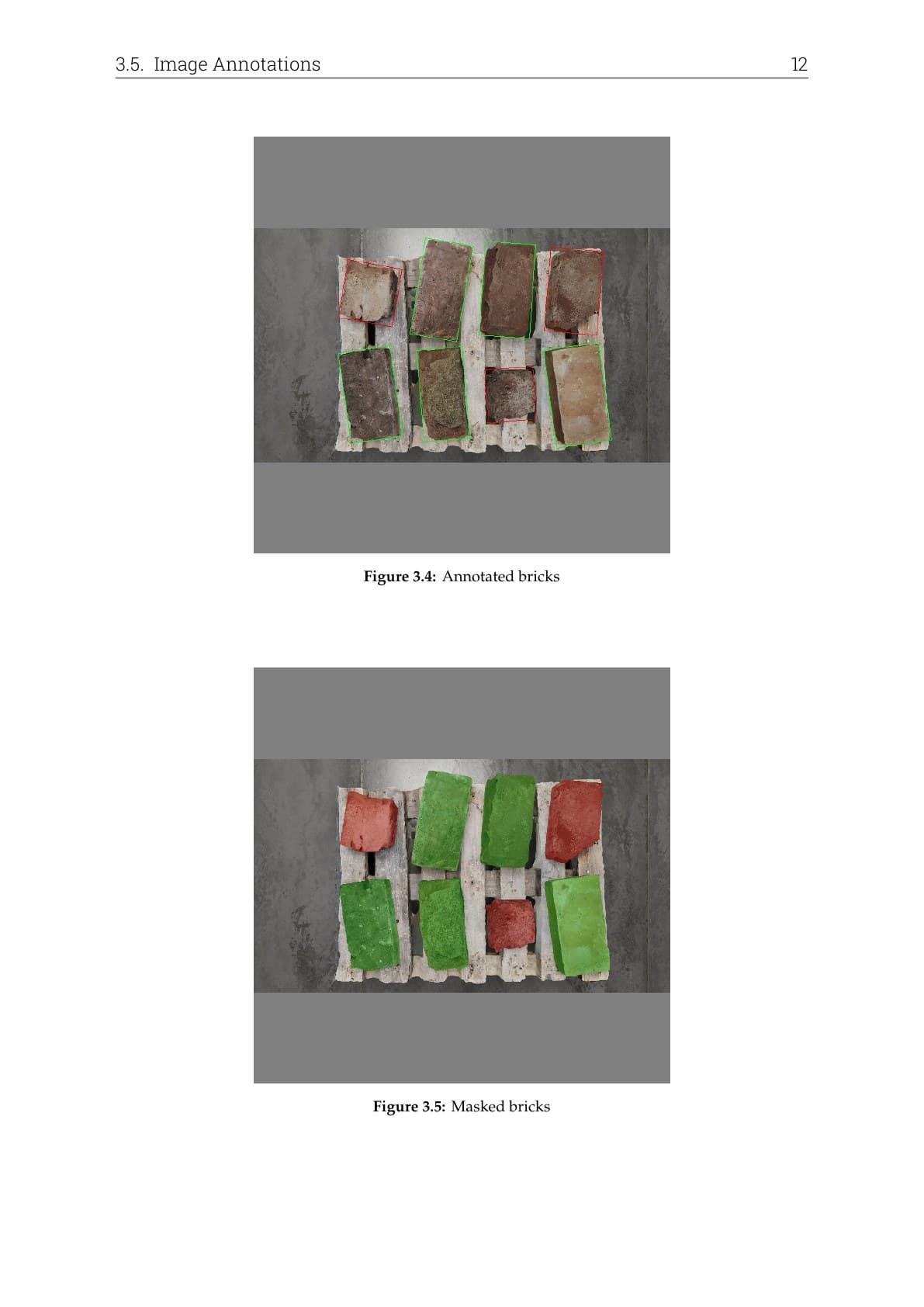
The supplied demo shows the system on a real UR robot: a wrist-mounted camera detects each brick with an oriented bounding box, the robot grasps it with a custom gripper, and a second camera checks the underside before the brick is sorted.
- 30
- 3D-scanned bricks
- 2,100
- images in largest training run
- 0.96
- demo detection confidence
Approach
- 01
Detect from above
A RealSense camera on the robot's tool head scans the work surface. Oriented-box YOLO models, trained on real images and BlenderProc scenes built from 30 Polycam brick scans with automatic annotations, return each brick's position, rotation, and a first usable call.
- 02
Inspect from below
Bricks that pass are carried to a single-camera stand that images the bottom face. Both views confirm the grade, with Segment Anything isolating mortar residue and surface damage on each face.
- 03
Grip and sort
ROS 2 and MoveIt plan every motion under hand-eye calibration, while widened Robotiq fingers with 3D-printed TPU surfaces keep irregular, mortar-covered bricks from slipping. Confirmed bricks are set aside for reuse; the rest are discarded.
Outcome
The demonstration pipeline ran on the real robot: the supplied footage shows a brick classified as usable at 0.96 confidence and carried away cleanly. The original five-camera inspection stand was simplified to a single camera without losing classification accuracy, and a feeder-and-conveyor pipeline was designed as the production-stage successor.