Bachelor's thesis / 2024
3D Template Matching
A marker-less identification pipeline that turns CAD models into trained detectors for 3D-printed components.
Overview
Industrial vision systems need substantial labelled data, but collecting it for custom 3D-printed parts is slow. This thesis built a modular pipeline that starts with the part's CAD geometry and produces the training data automatically.
The study also tested whether edge extraction and neural drawing styles could reduce the visual gap between synthetic renders and real camera images.
- 40
- models trained
- 8
- visual treatments
- 1,000
- renders per object
Approach
- 01
Generate
Blender and BlenderProc place each CAD model in a controlled scene, vary pose, color, lighting, and camera position, then render 1,000 images per object.
- 02
Prepare
Known scene geometry supplies pixel-accurate masks and oriented boxes. The pipeline builds eight parallel datasets using color, edge detection, and drawing-style transformations.
- 03
Train and compare
Five YOLOv11-OBB model sizes were trained across the eight treatments, producing 40 models evaluated for accuracy, confidence, and inference time.
Outcome
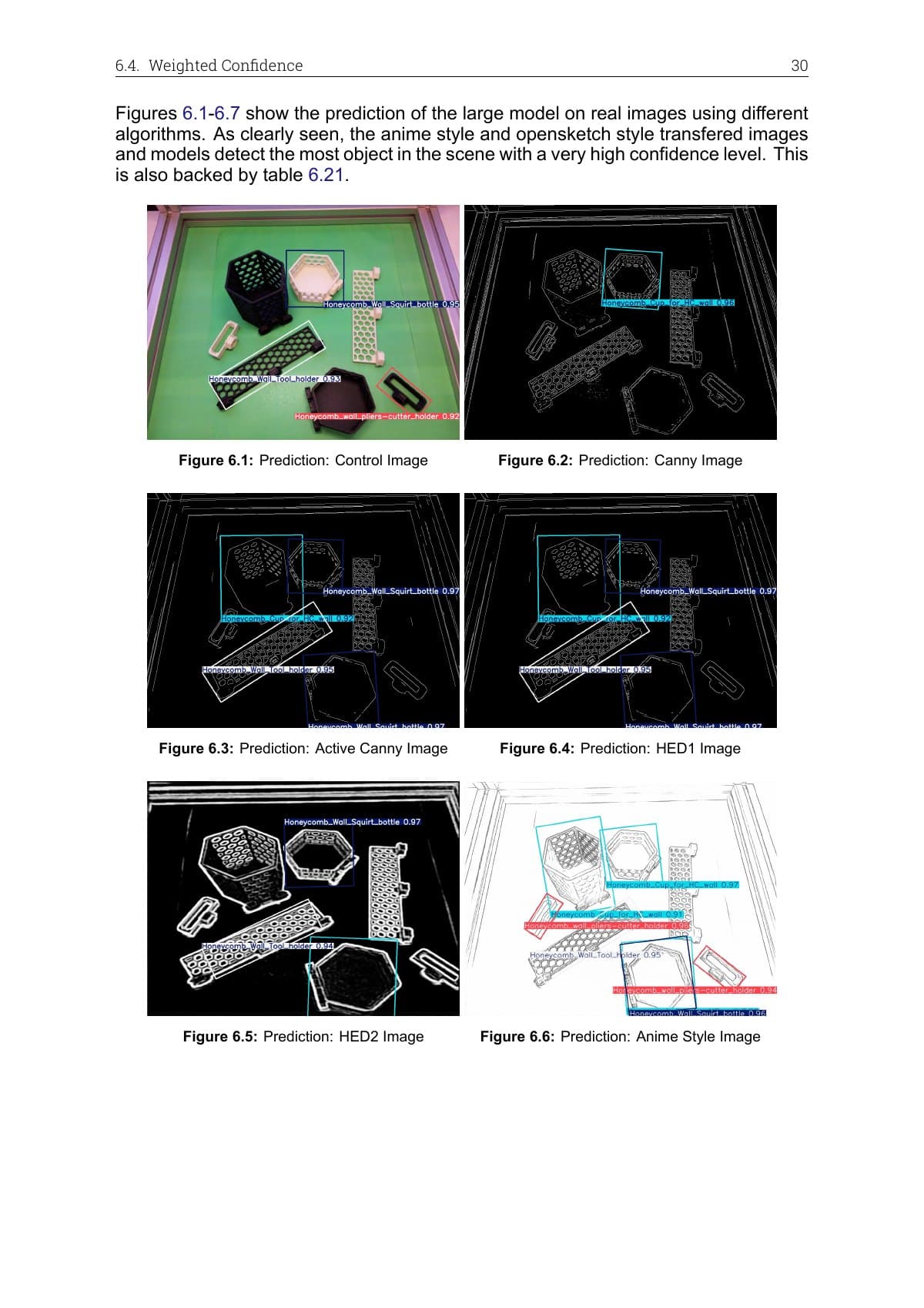
Validation mAP50-90 remained around 0.97-0.99 across the study. On real images, anime, OpenSketch, and contour transformations produced the strongest weighted confidence, while simpler edge filters were faster but less robust.